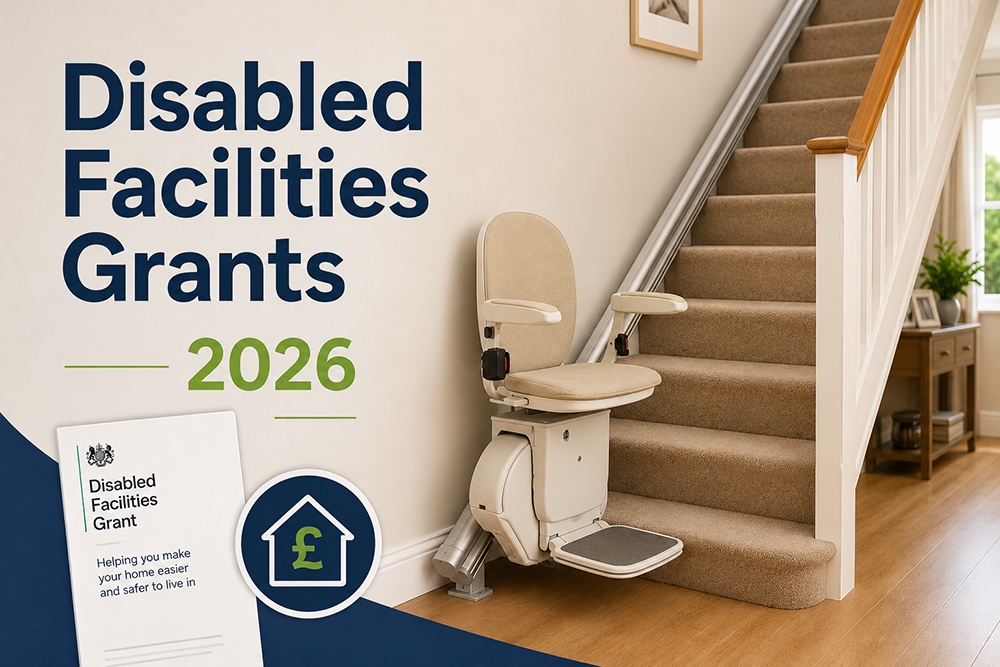
Yes, you can get help paying for a stairlift. The main route is the Disabled Facilities Grant, or DFG, a means-tested grant from your local council worth up to £30,000 in England, £36,000 in Wales and £25,000 in Northern Ireland. Scotland runs its own scheme. It can cover some or all of the cost of supplying and fitting a stairlift, and you apply through your council before any work begins.
Losing confidence on the stairs is frightening, whether it is happening to you or to someone you love. The good news is that you may not have to pay for the solution on your own. Below we explain, in plain English, exactly how the Disabled Facilities Grant works in 2026, who can get it, how much you might receive, how to apply, and what your options are if the grant is not available to you.
- Who provides it: your local council, using money from central government.
- How much: up to £30,000 (England), £36,000 (Wales), £25,000 (Northern Ireland). Scotland has a separate scheme.
- Means tested: yes for adults, no for children under 18.
- What it covers: supplying and fitting a stairlift, plus other home adaptations.
- When to apply: before any work starts.
- Decision: in writing, within six months of a valid application.
Can you get a stairlift for free?
Sometimes, yes. If you or someone in your household is disabled and on a low income, a Disabled Facilities Grant can cover the whole cost of a stairlift, fitting included. It is not automatic, though. Because the grant is means tested for adults, a higher income or savings above £6,000 may mean you are offered only part of the cost, or nothing at all. For a disabled child under 18, the grant is not means tested, so a family's finances are not taken into account.
It is also worth knowing that most people do not pay VAT on a stairlift in the first place. If the user is chronically sick or disabled, the supply and fitting are zero-rated, which is a saving of 20 per cent before any grant is even considered. You can read more on our stairlift costs guide.
What is a Disabled Facilities Grant?
A Disabled Facilities Grant is money from your local council to help pay for changes that make your home safer and easier to live in when you are disabled or your mobility has reduced. A stairlift is one of the most common adaptations it pays for, but the same grant can also cover things like access ramps, level-access showers, wet rooms, door widening and lower thresholds.
The money comes from central government but is handed out, and decided on, by your local council. That is why the exact process and the length of the waiting list can vary depending on where you live.
Who is eligible?
To receive a grant, three things need to be true. There must be a disabled person in the household, whether that is you or someone who lives with you. The work must be necessary and appropriate for that person's needs, which an occupational therapist will confirm. And it must be reasonable and practical to carry out the work in your particular property.
You also need to intend to live in the home for at least five years. If you move sooner, you may be asked to repay some of the money. Homeowners and tenants can both apply, and if you own a property and rent it to a disabled tenant, you can apply on their behalf.
Always apply before any work begins. If the stairlift is already fitted by the time you apply, you will usually lose the right to the grant.
How to apply, step by step
The application has a clear shape once you know what to expect. Here is the order it usually runs in.
- Contact your local council. Ask about the Disabled Facilities Grant. You will normally be passed to the housing adaptations or adult social care team, who send out the form. If the paperwork feels daunting, your local Home Improvement Agency can help you fill it in.
- Have an occupational therapist assessment. An occupational therapist visits to look at the stairs and confirm that a stairlift is the right answer for the person's needs. Their view carries real weight in the final decision.
- Get quotes from a reputable installer. The council usually wants two written quotes. Any good stairlift company will survey your stairs and give you a free, no obligation quote to submit.
- Submit the application before work starts. The form asks for your details, why the stairlift is needed and how the disability affects daily life, and your financial information. Include bank statements as proof.
- Council survey and means test. The council arranges its own visit to check the work is feasible, and carries out the means test on your income and savings (skipped entirely if the user is under 18).
- Receive the decision and payment. You get a written decision within six months. If it is approved, the council pays the full cost or a share of it, usually once the work is done, either to you or straight to the installer.
How much could you get?
The amount depends on the cost of the work and on your finances. If you are on a low income, the grant can cover the entire cost of your stairlift. If your income or savings are higher, you may still be offered a grant, but it might only cover part of the bill.
The maximum a council can award is set by where you live: £30,000 in England, £36,000 in Wales and £25,000 in Northern Ireland. Those caps sound large next to the price of a stairlift, and they are, because the same grant is designed to stretch to major building work for people who need it. Savings below £6,000 are ignored in the means test. For grants over £5,000, the council can place a charge on your home and reclaim up to £10,000 if you sell within ten years.
How long does it take?
Be prepared for months rather than weeks. The assessments, quotes and council survey all take time, and busy departments can have waiting lists. By law, the council must give you a written decision within six months of a valid application. If your situation is urgent, for example someone coming home from hospital, say so when you request the form, because your case may be moved up the queue. Remember that you must wait for the decision before the work starts if you want the grant to pay for it.
Financial help in Scotland
Scotland does not use the Disabled Facilities Grant. Instead, help with adaptations is provided by your local council through its Scheme of Assistance, and it may come as a grant, a loan, or practical support. Essential adaptations for a disabled person are often fully funded for households receiving certain income-related benefits, with a contribution expected from others. As the rules vary locally, it is best to contact your council directly to find out what is available in your area.
Is a stairlift free on the NHS?
Not as a rule. The NHS does not fit stairlifts as standard equipment. It may help in specific circumstances, such as a short-term equipment loan after a stroke or major operation, provision for a disabled child through a community team, or support as part of palliative care at home. These routes usually go through your GP, the hospital discharge team or social services, rather than a grant application.
What if you don't qualify, or the grant falls short?
A refused application, or a grant that only covers part of the cost, is not the end of the road. There are several ways to bring the price down:
- Reconditioned stairlifts. A good quality reconditioned model, with a warranty, can cost far less than new. See our guide to stairlift costs.
- Rental. If the need is temporary, renting can be more sensible than buying.
- VAT relief. Remember the 20 per cent VAT saving that applies when the user is chronically sick or disabled.
- Charities. Turn2us helps you find grants from a range of organisations, Age UK offers advice, the Family Fund can help families with a disabled child, and SSAFA supports current and former armed forces personnel.
Complaints and appeals
If you think a decision was wrong, you can appeal. Ask the council to explain its complaints and appeals procedure. If you still feel you have been treated unfairly, you can raise the matter with the Local Government and Social Care Ombudsman.
Where to get help
- The government's DFG guidance: gov.uk/disabled-facilities-grants.
- Find your local council: the DFG is run by your council, so start with gov.uk/find-your-local-council.
- Home Improvement Agencies: non-profit teams that help with the application. Try Foundations in England, Care and Repair Cymru in Wales, and Care and Repair Scotland.
Grant amounts, savings limits and local rules can change and vary from one council to the next. Use this guide to understand how the system works, then confirm the current details with your own council before you apply.
Whether or not a grant covers it, we can help you find the right stairlift at the best possible price. Get a free, no obligation quote and honest advice from people who do this every day.
Stairlift grant FAQs
Can I get a stairlift for free?
Possibly. If you or someone in your household is disabled and on a low income, a Disabled Facilities Grant from your local council can cover the full cost of supplying and fitting a stairlift. It is means tested for adults, so a higher income or savings above £6,000 may mean you receive only part of the cost or none of it. For a child under 18 the grant is not means tested.
Who qualifies for a Disabled Facilities Grant?
You qualify if you or someone living with you is disabled, the work is necessary and appropriate for their needs, and it is reasonable and practical to carry it out in the property. You need to intend to stay in the home for at least five years. Homeowners, tenants and landlords applying on behalf of a disabled tenant can all apply.
How much is the Disabled Facilities Grant?
The maximum grant is £30,000 in England, £36,000 in Wales and £25,000 in Northern Ireland. Scotland does not use the DFG and runs its own scheme through local councils. These caps are far higher than a typical stairlift because the grant also covers larger adaptations such as ramps, wet rooms and door widening.
Is the Disabled Facilities Grant means tested?
Yes, for adults. The council looks at your income and savings to decide how much to pay. Savings under £6,000 are ignored. If the grant is for a disabled child under the age of 19, it is not means tested at all.
How long does a Disabled Facilities Grant take?
Expect the whole process to take months rather than weeks, because of the assessments and surveys involved. The council must give you a written decision within six months of a valid application. If your need is urgent, say so when you request the form, as your case may be prioritised.
Do I have to pay a Disabled Facilities Grant back?
Usually not. For grants over £5,000, the council can place a charge on your home and reclaim up to £10,000 if you sell within ten years. Below that amount there is normally nothing to repay, as long as you met the conditions when you applied.
Are stairlifts free on the NHS?
The NHS does not usually fit stairlifts as standard equipment. In some situations it may help, such as short-term equipment loans after a hospital stay, provision for children through community teams, or palliative care at home. The route is normally through your GP, hospital discharge team or social services.
Can I apply for a grant for a tenant?
Yes. If you own a property and let it to a disabled tenant, you can apply for a Disabled Facilities Grant on their behalf, provided the tenant intends to stay in the home for at least five years and the work is agreed as necessary.
What if my application is refused?
You can ask the council about its complaints and appeals process, and you can take the matter to the Local Government and Social Care Ombudsman if you feel you were treated unfairly. Even if a DFG is not available, charities and reconditioned or rental options can still bring the cost down.
Can I choose my own stairlift installer?
In most cases yes. The council usually asks for two quotes, and you are free to obtain these from reputable installers of your choice. If you would rather not arrange it yourself, the council or a Home Improvement Agency can point you to a local firm.